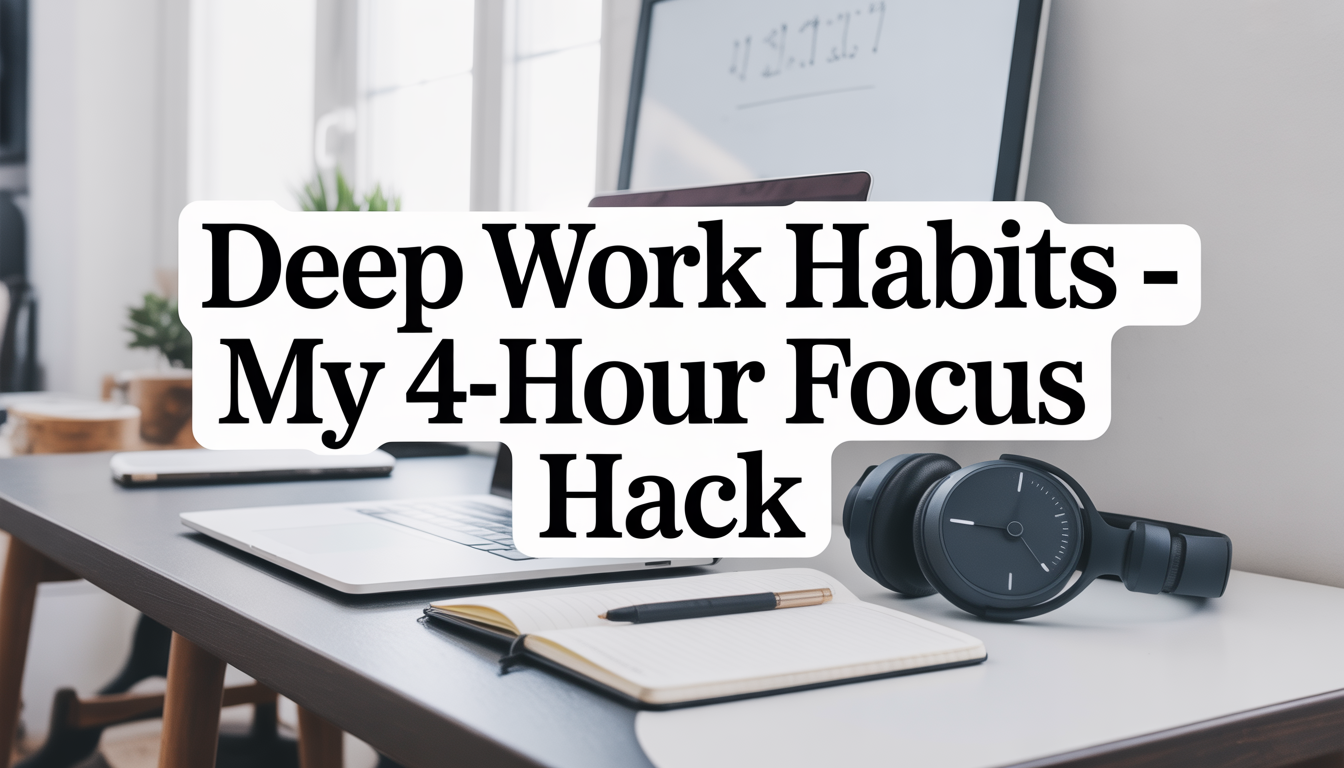
I used to be a world-class professional at “looking busy.” I would spend eight hours a day at my desk, frantically typing emails, checking Slack every thirty seconds, and moving colored boxes around on my calendar. By 5:00 PM, I was exhausted, but when I looked at my actual goals, I realized I hadn’t moved the needle an inch. I was stuck in a cycle of “shallow work,” drowning in a sea of pings and notifications. Then, I stumbled upon a radical concept that changed my life: I didn’t need more time; I needed more focus. I developed a 4-hour focus hack that produces more results in a morning than I used to get in an entire week.
The Myth of the 8-Hour Workday:
We were raised to believe that work is a marathon. We are told that if you sit in a chair for eight to ten hours, you are a “hard worker.” But here is a secret that the most successful people in the world know: the human brain isn’t built for marathons; it’s built for sprints.
When I was trying to work all day, I was actually only “deeply” working for maybe twenty minutes at a time. The rest of the time was spent on what researchers call “attention residue.” This happens when you check an email, and even though you go back to your main task, part of your brain is still thinking about that email. It’s like trying to drive a car with the emergency brake on.
I decided to stop fighting my biology. I stopped trying to be busy and started trying to be effective. This led me to the world of deep work habits. I realized that if I could protect just four hours of my day from the outside world, I could outpace everyone around me. This isn’t just a productivity tip; it’s a mental revolution.
What Exactly is the 4-Hour Focus Hack?
My hack isn’t about working more; it’s about working deeper. It is built on a very specific structure that protects the most valuable resource you have: your attention. Most people treat their attention like a piece of candy they give away to anyone who asks. I treat mine like a vault in a high-security bank.
The hack is broken down into a “90-20-90” structure.
- The First 90 Minutes: This is the “God Mode” block. No internet, no phone, no people. Just you and your hardest task.
- The 20-Minute Refuel: A complete break. No screens. Just walking, stretching, or staring at a wall.
- The Second 90 Minutes: This is the “Execution” block. You finish what you started or tackle the next big piece of the puzzle.
When you add it up, it’s only three hours of intense work, with a final hour dedicated to “admin” and “planning.” But in those three hours, your brain enters what psychologists call a flow state. In a flow state, your sense of time disappears, your ego vanishes, and your performance skyrockets. This is the ultimate goal of any personal development journey.
The “Morning Monk” Ritual:
I learned early on that you cannot just “decide” to focus. You have to lure focus into the room. If you wake up and immediately check your phone, you have already lost. You have let the “outrage machine” of social media or the “demand machine” of your inbox take control of your brain.
To make my 4-hour focus hack work, I became a “Morning Monk.”
- Zero Inputs: From the moment I wake up until my four hours are done, I take in zero information. No news, no podcasts, no social media.
- The Sensory Trigger: I use the same sensory cues every day. I wear noise-canceling headphones (even if no music is playing), I drink the same flavor of tea, and I sit in the same chair.
- The Clear Deck: My desk must be empty. If there are random papers or a dirty coffee mug in my peripheral vision, part of my brain is distracted by them.
This ritual tells my brain, “It is time to go deep.” By the time I sit down, my mind isn’t cluttered with other people’s problems. It is a blank canvas ready for my best work. This is one of the most powerful productivity hacks I have ever discovered.
Dealing With the “Digital Ghost”:
One of the hardest parts of building deep work habits is dealing with the “Digital Ghost”, that phantom feeling in your pocket where you think your phone is vibrating, or that subconscious itch to open a new tab and check the news.
I had to be ruthless. I didn’t just turn off notifications; I “killed” them. I used an app that literally locks me out of the internet for 90 minutes. I put my phone in a different room.
I remember the first time I did this. I felt a weird sense of panic. “What if someone needs me?” I thought. “What if there is an emergency?” Do you know what happened? Nothing. The world didn’t end. The “emergencies” were just other people’s poor planning. When I came out of my focus block, I realized that 99% of things can wait four hours. By protecting my time, I wasn’t being selfish; I was being professional.
The Science of 90-Minute Sprints:
Why 90 minutes? Why not two hours or thirty minutes? It all comes down to our “ultradian rhythms.” Most people know about circadian rhythms (the 24-hour sleep/wake cycle), but we also have shorter cycles during the day.
Our brains can typically handle high-intensity focus for about 90 minutes before the “waves” of energy start to crash. If you try to push past that, you hit a point of diminishing returns. You start making mistakes. You get frustrated.
By using my 4-hour focus hack, I am riding these waves. I work with my body, not against it. When I hit that 90-minute mark, I don’t “push through.” I stop. I walk away. This allows my brain to process the information in the background (incubation) while I rest. This is why some of my best ideas come to me while I’m making a sandwich during my 20-minute break.
The “Hardest Task First” Rule:
In my old life, I used to “warm up” by doing easy things. I would answer five emails, check my bank account, and tidy my folders. I thought I was getting ready to work. In reality, I was using up my best “focus fuel” on tasks that didn’t matter.
In the 4-hour focus hack, the first thing you do must be the thing you are most afraid of. It’s the task that makes you procrastinate. It’s the difficult writing, the complex coding, or the strategic planning.
I call this “Eating the Frog.” If you eat a live frog first thing in the morning, nothing worse can happen to you the rest of the day. When you finish your hardest task by 10:30 AM, you feel like a superhero. The rest of the day feels like a victory lap. This build of confidence is a massive part of high-performance habits.
Why Multitasking is a Lie:
I used to be proud of my ability to multitask. I thought it meant I was fast. Now, I know it just meant I was doing three things badly at the same time. Research shows that every time you switch tasks, you lose up to 20% of your cognitive capacity.
If you are writing a report and you “just check a quick text,” you have just lowered your IQ for the next ten minutes. It is a biological fact.
My 4-hour focus hack is built on “mono-tasking.” One goal. One screen. One mission. If I am writing a blog, I am only writing a blog. I don’t look up facts while I write (I just put a placeholder like [FACT HERE] and keep going). I don’t fix spelling. I just produce. This “unbroken focus” is what allows you to finish in four hours what takes others forty.
My Journey from Burnout to Balance:
I want to be authentic with you. I didn’t start this because I was a productivity guru. I started it because I was burning out. I was working 12-hour days and was miserable. My relationships were suffering, my health was declining, and I wasn’t even producing great work.
I thought that to be successful, I had to suffer. I thought stress was a badge of honor. I was wrong.
When I moved to the 4-hour focus hack, I felt guilty at first. I felt like I was “cheating” because I was done with my main work by noon. I had to learn that “hours worked” is a terrible metric for success. “Value created” is the only thing that matters.
Once I embraced this, my life changed. I had my afternoons back. I could go for walks, read books, and spend time with my family. And ironically, my career took off faster than ever because the quality of my “deep” work was so much higher. This is a lesson in digital minimalism and life balance that I wish I had learned ten years ago.
The Power of the “Done” List:
Most people have a “To-Do” list that is twenty items long and impossible to finish. This creates a feeling of failure every night when you don’t check everything off.
I use a “Focus Two” list. Before I go to bed, I write down the only two things that must happen during my focus block the next day. Just two.
When I finish my 4-hour block, I check those two items off. I am “done.” Anything I do in the afternoon—meetings, emails, errands—is just a bonus. This “Win the Morning, Win the Day” philosophy has removed 90% of the anxiety from my life. It turns work from a mountain you have to climb into a series of short, manageable sprints.
Creating a Physical “Focus Fortress”:
Your environment is the invisible hand that shapes your behavior. If you try to do deep work habits in a place where people are constantly walking by or where a TV is on, you are setting yourself up for failure.
I created a “Focus Fortress.” It’s not a fancy office; it’s just a corner of my bedroom. But when I am in that corner, I am “off-grid.”
- Visual Boundaries: I use a “Do Not Disturb” sign on my door. My family knows that if that sign is up, the house better be on fire before they knock.
- Digital Boundaries: I use a secondary user profile on my computer that has no bookmarks, no saved passwords for social media, and a boring grey background.
- The Phone Jail: I actually bought a timed lockbox for my phone. I put it in, set it for four hours, and I literally cannot get to it.
By making distraction physically difficult, I make focus mentally easy. This is a key focus for high achievers. Don’t rely on willpower; rely on your environment.
Overcoming the “Boredom Gap”:
The biggest enemy of deep work isn’t the internet; it’s boredom. Deep work is hard. It makes your brain “itch.” There is a moment, usually about twenty minutes into a session, where your brain starts screaming for a distraction. It wants a hit of dopamine.
Most people give in. They check their phone “for a second.” That second kills the flow.
I call this the “Boredom Gap.” You have to learn to sit with that discomfort. When the itch comes, I just acknowledge it. “Oh, my brain is bored because this is hard,” I say to myself. Then I take three deep breaths and go back to work. If you can push through that ten-minute gap, you will slide into the flow state on the other side. This is where the magic happens.
The Role of Rest in High Performance:
You cannot have a 4-hour focus hack without high-quality rest. If you spend your evening staring at a screen or worrying about work, your brain won’t “recharge” its focus fuel for the next day.
I treat my rest as seriously as my work.
- Digital Sunset: At 8:00 PM, all screens go off.
- Nature Therapy: I spend at least 30 minutes outside every afternoon.
- Active Recovery: I do things that require “soft fascination,” like gardening or cooking, which allow my brain to rest while still being engaged.
Focus is a limited resource. Think of it like a battery. Deep work drains the battery. Rest refills it. If you don’t refill it, your 4-hour block tomorrow will be a 4-hour block of staring blankly at your screen. This is a core concept in personal development.
How to Scale This in a “Normal” Job:
I know what you are thinking. “This is great for you, but I have a boss and a team and people who expect me to be available.”
I have helped many people in corporate jobs implement this. You don’t have to start with four hours. Start with one.
- The “Early Bird” Strategy: Get to work an hour early and do your deep work before anyone else arrives.
- The Calendar Block: Put a “Meeting with Myself” on your shared calendar. Most people won’t question it.
- Communication: Tell your team, “I’m going to be heads-down on [Project X] from 9 to 11 to make sure it’s perfect. If it’s an emergency, call me; otherwise, I’ll reply to all messages at 11:15.”
When you show people that you are producing higher-quality work and never missing deadlines, they will stop caring that you weren’t on Slack for two hours. They will actually start to respect your time more. You are training people how to treat you.
The Long-Term Gains of Deep Work:
If you do this for one day, you will feel productive. If you do it for a year, you will be unrecognizable.
Most people are moving through life at 2 miles per hour because they are constantly stopping and starting. When you use the 4-hour focus hack, you are moving at 100 miles per hour in a straight line.
Over a year, that adds up to a massive amount of “distance” covered. You could write a book, launch a business, learn a new language, or master a difficult skill, all while working fewer hours than everyone else. This is how the “overnight success” stories actually happen. It’s not luck; it’s the compound interest of focused attention.
My “Emergency” Focus Reset:
There are some days when the hack doesn’t work. I’m human. Maybe I didn’t sleep well, or maybe I’m worried about something personal. On those days, my brain feels like a box of bouncy balls.
When this happens, I don’t try to force the 4-hour block. I do a “Reset.”
- Change of Scenery: I go to a library or a coffee shop.
- The 5-Minute Entry: I tell myself I only have to work for five minutes. Usually, once I start, the resistance disappears.
- The “Mind Dump”: I write down everything I’m worried about on a piece of paper to get it out of my head.
Being flexible is part of a strong content strategy for your life. Don’t let one bad day break your habit. Just reset and try again tomorrow.
Bottom Line:
The world is getting noisier every day. The companies that build your phone and your apps are spending billions of dollars to try to steal your attention. If you don’t have a plan to protect it, they will win. My 4-hour focus hack isn’t just about getting more work done; it’s about taking your life back. It’s about deciding that your goals and your dreams are more important than a “like” on a photo or a “reply” to a non-urgent email. You have greatness inside you, but it’s hidden under a layer of noise. Turn down the volume, clear the deck, and see what you can achieve when you finally decide to focus.
FAQs:
1. What if I can’t find 4 hours of quiet time?
Break it into two 2-hour blocks. It’s not ideal, but it’s still 100 times better than working in 10-minute bursts all day.
2. Is it okay to listen to music during deep work?
Only if it’s “low-information” music, like lo-fi beats, classical, or white noise. Avoid anything with lyrics, as your brain will try to process the words instead of your work.
3. What should I do during my 20-minute break?
Get away from your desk. Walk, stretch, get a glass of water, or do a quick chore. The key is to avoid “input” (don’t check your phone!).
4. How do I handle my boss if they want me available 24/7?
Show them the results. When your work is clearly better than everyone else’s, most bosses will be happy to let you work however you want.
5. Does this work for creative work or just technical work?
It works even better for creative work! Creativity requires long periods of uninterrupted thought to “connect the dots” in your brain.
6. What happens if I get interrupted in the middle of a block?
Don’t get angry. Just deal with the interruption as quickly as possible and use a “re-entry ritual” (like three deep breaths) to get back into the zone.
About the Author
