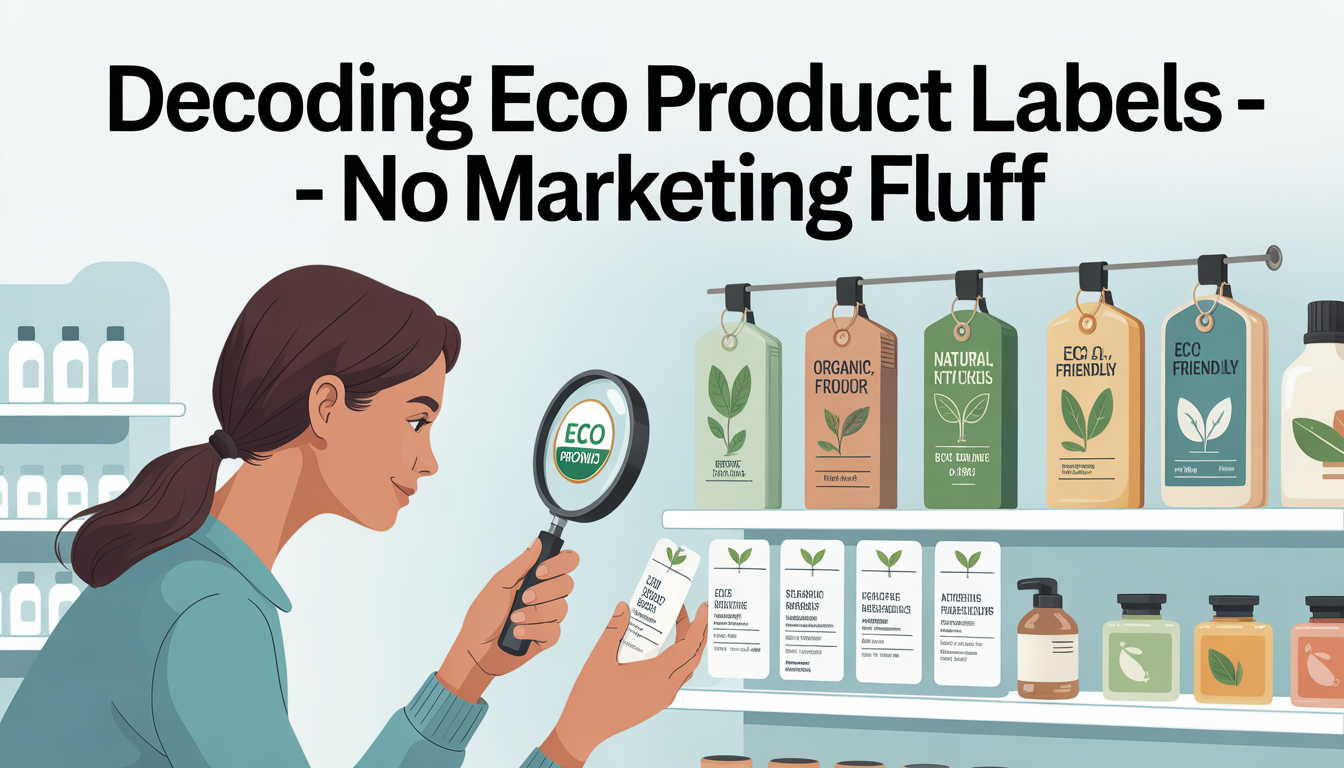
I remember standing in the middle of the cleaning aisle last Tuesday, clutching a bottle of dish soap that looked like it had been designed by a professional gardener. The bottle was a soft, earthy brown, the label featured a beautiful hand-drawn leaf, and the words “Natural” and “Eco-Friendly” were printed in a very trustworthy green font. I felt like a hero for putting it in my cart. But as I turned the bottle around and tried to read the tiny print on the back, I realized I had no idea what any of it actually meant. Was it really better for the planet, or was I just paying an extra three dollars for a very pretty piece of plastic? That was the day I decided to stop being a victim of clever marketing and started my journey into decoding eco product labels, and I am going to tell you exactly how I learned to spot the difference between a real environmental promise and total “greenwashing” fluff.
The Day the Green Veil Lifted:
There is a very specific kind of confusion that happens when you try to do the right thing in a modern grocery store. We are bombarded with terms like “earth-friendly,” “sustainably sourced,” and “pure,” but these words are often what experts call “fluff.” They sound amazing, but they have no legal definition. I used to think that if a company took the time to put a picture of a mountain on their packaging, they must care about the environment. I was very wrong. I spent weeks researching the laws behind these claims, and I discovered that many of the most popular terms are completely unregulated.
I felt a mix of anger and empowerment. I realized that the power isn’t in the hands of the marketing teams; it is in the hands of the person holding the wallet. If I could learn the “secret language” of real sustainable living, I could make sure my money was actually going toward companies that are doing the hard work of protecting our world. I decided to create a master guide for myself, a way to cut through the noise and find the “designer gold” of the eco-world. This is not just about shopping; it is about taking back control of our impact on the earth.
The Psychology of the “Green” Trap:
The first thing I had to learn was how our brains are wired to trust certain colors and textures. Marketing companies spend millions of dollars studying how to make us feel “eco-conscious” without actually changing their products. I call this the “brown paper bag effect.” If a product comes in a box that looks like recycled cardboard, we automatically assume it is better for the environment. I once bought a set of “eco” pens simply because the box was a dull tan color. When I got home, I realized the pens were made of the same cheap, non-recycled plastic as every other pen I had ever owned.
This is a classic example of greenwashing. It is a strategy where a company spends more time and money on advertising being “green” than on actually minimizing their environmental impact. They use soft greens, sky blues, and earthy browns to trigger a sense of calm and trust in our minds. I learned that I have to ignore the colors and the pretty pictures of flowers. Instead, I look for specific, third-party seals of approval. These are the “labels of truth” that a company cannot just print on their own; they have to earn them through a rigorous testing process.
The “Natural” Myth vs. The Organic Reality:
One of the biggest hurdles in my ethical shopping journey was understanding the word “natural.” This word is everywhere, from your shampoo to your breakfast cereal. Here is the cold, hard truth: in most countries, the word “natural” means absolutely nothing when it comes to regulation. A company can put “natural” on a product that is full of synthetic chemicals, as long as some part of the ingredients originally came from a plant or a mineral.
On the other hand, the word “organic” is highly regulated, especially when it is backed by the USDA Organic seal. When I see that green and white circle, I know that the product has met very strict standards.
- The Three-Year Rule: For a farm to be certified organic, the soil must be free of prohibited substances for at least three years before the harvest.
- No Synthetic Pesticides: You won’t find the harsh chemicals that are common in industrial farming in these products.
- Non-GMO: Organic products cannot use genetically modified organisms, which is a huge part of sustainable agriculture.
I remember when I finally understood this difference. I looked at my “natural” face wash and realized it had a list of ingredients longer than a dictionary. I switched to a certified organic version, and not only did my skin feel better, but I felt better knowing I wasn’t supporting the use of toxic pesticides in the soil.
Trustworthy Third-Party Certifications: The Gold Standard:
If you want to cut through the marketing fluff, you have to look for the “heavy hitters” of the certification world. These are organizations that have no stake in the company’s profits and only care about the standards. I have a mental checklist of five labels that I look for every time I enter a store.
The first is the Leaping Bunny seal. This is the only internationally recognized guarantee that no animal testing was used in any stage of product development. I used to see “cruelty-free” written on bottles, but I didn’t realize that a brand could claim that even if their “parent company” or their “ingredient suppliers” were still testing on animals. The Leaping Bunny doesn’t allow any of those loopholes. When I see that little rabbit, I know I am supporting a truly ethical supply chain.
The second is Fair Trade Certified. This is about the people as much as the planet. It ensures that the farmers and workers who made the product were paid a fair wage and worked in safe conditions. I always look for this on my coffee, chocolate, and cotton items. It turns my morning cup of coffee into a small act of global justice.
| Label Name | What It Really Means | Best For |
| USDA Organic | No synthetic pesticides or GMOs | Food and Skincare |
| Fair Trade | Fair wages and safe working conditions | Coffee, Cocoa, Cotton |
| FSC Certified | Forest products from managed sources | Paper and Wood |
| Energy Star | High energy efficiency standards | Electronics and Appliances |
| GOTS | High standards for organic textiles | Clothing and Bedding |
The Cleaning Aisle Confusion: Biodegradable vs. Compostable:
This was a major point of confusion for me for a long time. I used to think that if something was “biodegradable,” it was the same as being “compostable.” I was wrong, and this mistake can actually hurt the environment. I learned that almost everything is “biodegradable” if you give it enough time, even some plastics will eventually break down over hundreds of years. The label “biodegradable” on a soap bottle doesn’t tell you how long it takes or what it leaves behind.
Compostable is a much stricter term. If a product is certified compostable, it means it will break down in a specific amount of time and turn into nutrient-rich soil without leaving any toxic residue behind. This is a massive part of waste reduction.
I once bought “biodegradable” trash bags, thinking I was helping. I later found out that they just break down into tiny “micro-plastics” that are even harder to clean up. Now, I only look for the “BPI Certified Compostable” label. It taught me that we have to be very careful with the words companies use to describe how things “disappear.”
Textiles and Fashion: Decoding Your Closet:
My journey into sustainable living eventually led me to my closet. I realized that the fashion industry is one of the biggest polluters in the world, and the labels on our clothes are just as confusing as the ones on our food. I used to buy “100 percent cotton” and think I was doing a good job. But conventional cotton is one of the “dirtiest” crops in the world, using a massive amount of water and pesticides.
Now, I look for the GOTS (Global Organic Textile Standard) label. This is the “gold standard” for clothing. It covers everything from how the cotton is grown to how the workers are treated in the factory. It even regulates the dyes used to color the fabric, making sure they don’t contain heavy metals that could hurt your skin or the water supply.
I also look for the OEKO-TEX seal. This doesn’t necessarily mean the fabric is organic, but it does mean that the finished product has been tested for over a hundred harmful substances. If you have sensitive skin, as I do, this label is a lifesaver. It is like a safety guarantee for your body. When I wear an OEKO-TEX certified shirt, I don’t have to worry about the chemicals used in the factory soaking into my skin.
The Paper and Wood Puzzle: FSC vs. SFI:
When I was buying a new desk for my home office, I saw two different labels for “sustainable wood.” One was FSC (Forest Stewardship Council) and the other was SFI (Sustainable Forestry Initiative). I had to do a lot of digging to find out the difference, and it was a real eye-opener.
FSC is widely considered the more rigorous standard. It has stricter rules about protecting old-growth forests and the rights of indigenous people who live there. SFI was actually started by the logging industry itself. While it is better than nothing, many environmental groups see it as a “weaker” version of the FSC.
I decided that if I am going to buy a new wood product, I want it to be FSC certified. I remember finding a beautiful wooden bookshelf that had the FSC tree logo on the back. It cost a little bit more, but every time I look at it, I know that a forest somewhere was protected because of my choice. This kind of responsible consumption is how we save the lungs of our planet.
Electronics and Energy: More Than Just a Star:
Most of us know the Energy Star logo. It is on our refrigerators, our TVs, and our washing machines. But I wanted to know if it was really making a difference. I found out that Energy Star is a government-backed program that sets very high bars for energy efficiency. A dishwasher with this label uses about twelve percent less energy and twenty-five percent less water than a standard model.
But for tech lovers, there is another label you should know: EPEAT. This is a global rating system for electronics that looks at the whole life of the product. Does it use recycled plastic? Can it be easily repaired? Is it easy to recycle when you are done with it?
I used to just buy the newest, shiniest laptop, but now I check the EPEAT registry first. I want a computer that isn’t just fast, but also “gold” rated for its environmental impact. This is a huge part of fighting electronic waste, which is one of the fastest-growing problems in our modern world. It taught me that “eco-friendly” electronics are about more than just the battery life.
Personal Care and Beauty: The “Clean” Reality:
The beauty aisle is probably the most “fluff-filled” place in the entire world. Words like “clinical,” “dermatologist-tested,” and “clean” are thrown around like confetti. I had to learn to ignore all of it. Instead, I look for a few specific things that actually matter for my health and the environment.
First, I look for the “Reef-Safe” label on my sunscreen. I live near the coast, and I didn’t realize that common chemicals in sunscreen, like oxybenzone, are actually killing the coral reefs. When millions of people go swimming, we are essentially poisoning the ocean. Switching to a mineral-based, reef-safe sunscreen was a small change for me, but it is a huge win for the marine ecosystem.
I also look for “Paraben-Free” and “Phthalate-Free.” These are chemicals that can mess with your hormones, and many countries are starting to ban them. I realized that my skin is my largest organ, and whatever I put on it goes into my body. By choosing products with real, certified labels, I am protecting my own health as much as the planet’s.
The Checklist for a Smart Shopper:
After months of learning, I developed a simple routine that I use every time I shop. It has turned a stressful experience into a quick and easy process. I don’t get distracted by the pretty leaves and the green boxes anymore. I go straight for the facts.
- Turn it over: The front of the package is for the marketing team. The back of the package is where the truth lives.
- Look for the seal: If there is no third-party certification (like USDA, Fair Trade, or GOTS), I treat any environmental claim as a “maybe.”
- Read the ingredients: If I can’t pronounce the first five ingredients, I do a quick search on my phone to see what they are.
- Check the packaging: Is it in a plastic bottle inside a cardboard box? If there is too much “extra” packaging, the company might not be as “green” as they claim.
- Research the brand: Sometimes a great product is made by a company with a terrible environmental record. I like to support the “good guys” from top to bottom.
I remember the first time I went through this checklist at the store. It took me a long time, and I felt a bit silly. But now, it takes me five seconds. I can scan a shelf and pick out the real eco-friendly products almost instantly. It is like having a secret decoder ring for the grocery store.
My Personal Shopping Routine: Putting it All Together:
When I do my big shopping trip for the month, I have a specific plan. I start at the local farmer’s market for my produce. There are no labels there, but I can talk to the farmers directly. I ask them if they use pesticides and how they treat their soil. This is the ultimate form of sustainable living, because there is no packaging and no shipping.
When I have to go to the supermarket, I bring my own reusable bags, of course. I head to the bulk section first. I look for items like rice, beans, and nuts that I can put into my own glass jars. This completely removes the need for labels because the “product” is just the food itself.
If I am in the center aisles, I stick to my trusted brands. I know which companies have the B Corp certification, which means they are legally required to consider the impact of their decisions on their workers, customers, suppliers, community, and the environment. Supporting a B Corp is like voting for a better world with every dollar you spend. It makes me feel proud of my choices, even if I am just buying a box of crackers.
Why This Journey Matters for the Long Term:
Some people tell me that I am overthinking things. They say, “It is just a bottle of soap, who cares?” But I believe that our small choices are the only things that ever change the world. If enough of us stop buying the “marketing fluff” and start demanding real, certified sustainable products, the big companies will have to change. They follow the money, and we have the power to lead them in the right direction.
My home now feels like a sanctuary. Every product I use is something I have researched and trusted. There are no “silent killers” in my cleaning cabinet and no “toxic threads” in my bedsheets. I feel lighter, healthier, and more connected to the earth. I have learned that the best things in life don’t need a lot of marketing fluff. They just need to be honest, well-made, and kind to the planet.
I hope my journey helps you navigate your own path through the grocery store. It might feel overwhelming at first, but remember that every “real” label you find is a victory. You are not just a consumer; you are a guardian of the future. By decoding the labels, you are choosing a life of truth over a life of marketing, and that is a beautiful thing.
Conclusion:
Learning to read between the lines of product packaging is the most important skill for anyone living a sustainable life. By looking for third-party certifications and ignoring the pretty pictures, you ensure your lifestyle is truly helping the planet.
FAQs:
1. What is the most misleading label on the market today?
The word “Natural” is probably the biggest offender because it sounds good but has almost no legal meaning.
2. Does “Cruelty-Free” always mean no animal testing?
Not always. You must look for the Leaping Bunny logo to be 100 percent sure that the entire supply chain is clean.
3. Are organic products always more expensive?
Often they are, but you are paying for the extra labor and the lack of cheap, toxic chemicals used in the process.
4. Can a product have multiple eco-labels?
Yes, and that is usually a very good sign! A shirt might be both GOTS certified and Fair Trade.
5. What should I do if a product has no labels but claims to be “eco”?
You can check the company’s website for an “Impact Report” or contact them directly to ask about their standards.
6. Is “Recyclable” the same as “Recycled”?
No, “Recyclable” means it can be recycled, while “Recycled” means it was made from old materials.
About the Author
